 French painter Edgar Degas lived from 1843 – 1917, somewhat earlier than I had been aware of. I had done some research on Degas in the context of another OCA course and had been very impressed by his realistic depiction of scenes and people, for example in ‘The Cotton Exchange’, a painting dating from 1873.
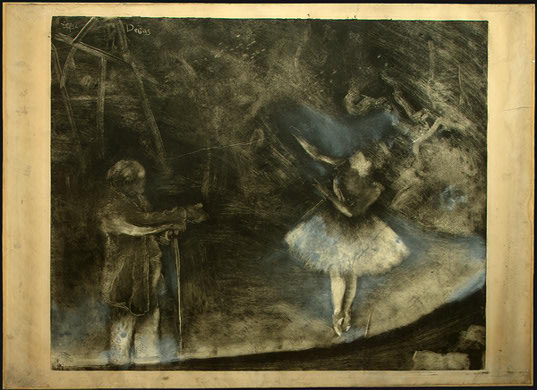
Apparently not much later, Degas was introduced to monoprinting techniques by Vicomte Lepic (1839-1889), contemporary of Degas in Paris and amateur printmaker. A very unusual piece was signed by them both, entitled ‘The Ballet Master’ (c. 1874). It is said to be mainly Degas’ work, who followed technical instructions by Lepic. It was made by spreading ink onto a printing plate and then scratching into the ink and wiping it off, using cloth and finger tips. After the print had dried, the lights were reworked with pastels or washes.
 There are also pure monotypes without pastel overdrawing, for example ‘The Sleep’ (1883-85) and ‘The Three Ballet Dancers’ (1878-80). I’m finding the ‘The Sleep’ difficult to read, but love the ballet dancers for the clarity of composition and the exquisite texture and tonality of the ballet dresses.

 While these prints seem to be made using softer implements, ‘The Jet Earring’ (1887-90) combines softer and scratchy marks to depict the profile of a woman with light reflections on the hair. The woman wears a little hat with something feathery on top – the marks work extremely well to make the clothes style of the late 19th century come alive. The monotypes represent a change in style – they are looser and more improvisational than earlier paintings. Yet it is apparent what a good observer Degas was.
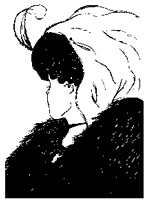
 On a side note, ‘The Jet Earring’ reminds me of one of the best known figure/ground switching examples, where the viewer’s perception switches between a young and an elderly woman in the same image. It is called the ‘Young Girl – Old Woman Illusion’, and the earliest source is attributed to an anonymous German postcard from 1988, then transformed by British cartooninst W. E. Hill in 1915. The resemblance to Degas’ monoprint may be accidental, but I find it nevertheless striking.
Then finally I would like to take a closer look at ‘The Star’ (L’étoile), among the best known ballet pastels by Degas. I was surprised to find two different versions of this painting: The fully developed one (dated c. 1876-77) which is located in the Museum of Pau, France, and a second one (dated 1976-78), which looks like a rough study, at the Philadelphia Museum of Art, in the U.S.. The dates do not permit to say which one was made earlier, but the two convey a sense of how an earlier stage of the painting looked which was then fully worked out as a pastel.


Possible impact
I can immediately relate to Degas’ monotype technique because it addresses a problem with which I struggled in the final assignment of the drawing course. I tried to depict a celery root, which had fine, linear root threads before a darker background. I experimented with oil pastels and Sgraffito technique, and scratched out lines in a dark background. Looking at Degas’ monotypes, I realize that this is a much more elegant solution than what I tried achieving with oil pastels, because the ink can be taken off the support much more easily.
There was a brief remark in the ‘First Monotypes’ project, suggesting to use a brush handle to make marks into the ink on the plate. I tried this without much enthusiasm and wasn’t quite sure whether I liked the effect or not. Degas’ monotypes however make me realize the potential of the technique. It might work better with oil-based printing ink because of the slower drying speed.
References
Article by Sharon Himes on Degas’ monoprints http://www.artcafe.net/artcafe/ah/degas/
British Museum: Edgar Degas, Le Sommeil (Sleep) , 1883-85 https://www.britishmuseum.org/explore/highlights/highlight_objects/pd/e/edgar_degas,_le_sommeil_sleep.aspx
British Museum: Edgar Degas, brief biography https://www.britishmuseum.org/explore/highlights/articles/h/hilaire_germain_edgar_degas.aspx
William Young for Akua Inks, History of the monotype (1996) http://www.akuainks.com/newsletters/newsletterhist.html , with a workable definition of monoprint vs. monotype
National Gallery of Art, Washington: The Ballet Master https://www.nga.gov/exhibitions/2001/unfinished/fullscreen/1964-8-1782.htm
Philadelphia Museum of art: Another version of ‘The Star’ (L’étoile) http://www.philamuseum.org/collections/permanent/72183.html?mulR=318365458|6
Edgar Degas, A Cotton Office in New Orleans (1873), oil on Canvas, 73 x 92 cm, from Wikipedia: http://en.wikipedia.org/wiki/A_Cotton_Office_in_New_Orleans (Musee des Beaux-Arts, Pau, France)
Young Girl – Old Woman Illusion, short Article from Wolfram Mathworld http://mathworld.wolfram.com/YoungGirl-OldWomanIllusion.html