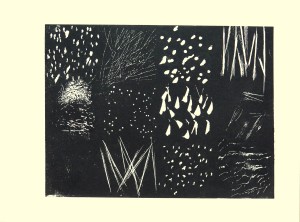
 The tools I used (plus the small scissors and a utility knife which didn’t make it into the photo) and the mark making on the lino (from left to right as printed on paper)
Row 1:
1) Hole puncher to dig up the lino
2) Hole puncher to cut sharp lines
3) Screwdriver with crossed tip
4) Large handsaw
Row 2:
5) Utility knife used at an angle to slit into the lino, then coarse sandpaper to break open the surface
6) Punching holes using hammer and a nail
7) Digging with a woodworker’s chisel
8) Rubbing with very coarse sandpaper
Row 3:
9) Half the square was treated with medium coarse sandpaper, but this did not affect the printing properties of the lino surface
10) Saw-like cuts with a serrated knife
11) Digging into the lino with a fondue fork
12) Cutting into the lino with small scissors



Papers: White tagboard, white vellum bristol, cream printmaking paper (ca. 100 gsm), Kraft paper (ca. 80 gsm)
Some reflective thoughts
I liked this project for the experimental aspect and the surprising marks that resulted from the non-standard tools. But I did not feel very safe using them on the lino. It may be a matter of habit though. I’m finding the marks really interesting and think it’s enriching the visual vocabulary, compared to using only standard tools.
I was thinking about a safer way to use additional cutting tools. An electric hand driller might be an interesting way to work on the lino surface without having to apply so much physical force.
The medium coarse sandpaper did not have the intended effect. I thought it would result in a speckled print, but the ink just filled the roughness and printed evenly as if it was a smooth surface.
I don’t think that any particular theme emerges from the marks, but I like them for their abstract qualities, how they are irregularly breaking up the surface and create a texture effect.